
Neuroestrogen: The Brain’s Secret Weapon Against Hunger
Estrogen produced in the brain may help control appetite, offering new possibilities for obesity treatment
Estrogens are known for their role in reproduction, but a new study from Fujita Health University, Japan, reveals that neuroestrogens—estrogens produced in the brain—play a key role in appetite regulation. These brain-made hormones enhance the expression of a hunger-suppressing receptor in the hypothalamus and improve leptin sensitivity. The findings highlight a new biological pathway that could lead to innovative strategies for managing obesity and eating disorders.
Image: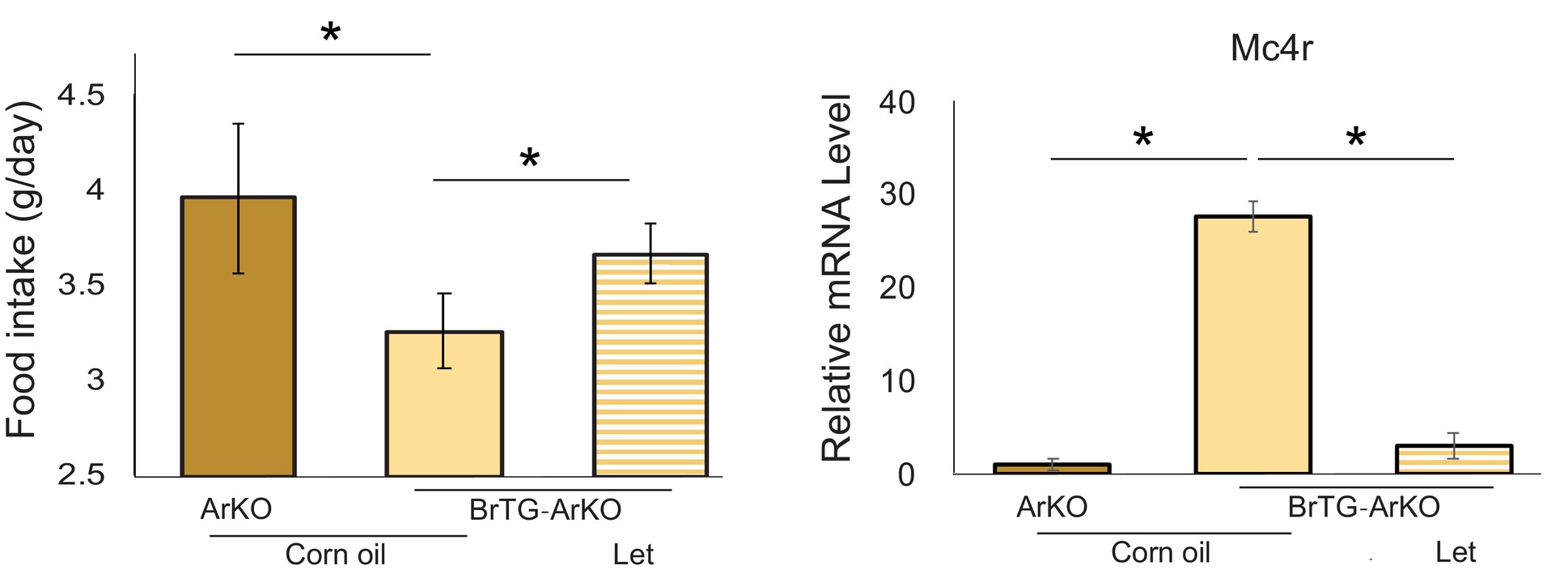 Image title: Restoration of Neuroestrogen Production Reduces Food Intake and Boosts MC4R Expression
Image caption: Comparison of food intake and hypothalamic MC4R mRNA levels between aromatase knockout (ArKO) mice and brain-specific aromatase-restored (BrTG-ArKO) mice (n = 5 per group). The data show that reactivating neuroestrogen synthesis leads to a significant reduction in food consumption along with an increase in MC4R expression in the hypothalamus.
Image credit: Takanori Hayashi from Fujita Health University School of Medicine
Image source link: here
License type: CC BY 4.0
Usage restrictions: Credit must be given to the creator.
For years, estrogens were known as the reproductive hormones produced by the ovaries, but recent discoveries reveal that these hormones are also synthesized in the brain through an enzyme called aromatase. This brain-specific version of estrogen is called neuroestrogen, and while its presence has been known, its precise function remained unclear—until now. Researchers from Fujita Health University reveal a groundbreaking discovery suggesting the direct role of neuroestrogen in appetite regulation.
“It is well known that MC4R (melanocortin-4 receptor) is an important receptor in the brain that regulates food intake,” explains lead author Takanori Hayashi, Associate Professor at Fujita Health University School of Medicine, Japan.
The study was led by Dr. Hayashi and Dr. Eiji Nishio from the Fujita Health University School of Medicine, in collaboration with Chiba University of Graduate School of Medicine and Fukuoka University, Japan. The findings of the study were published online in The FEBS Journal on February 18, 2025.
To investigate the role of neuroestrogens, the team employed several mouse models, comparing animals lacking estrogen production to those exhibiting active neuroestrogen synthesis. The mice without ovaries (OVX) and without aromatase (ArKO) showed a notable increase in body weight and food consumption when compared with normal mice.
However, when the aromatase gene was selectively reactivated in the brains of ArKO mice (BrTG-ArKO strain), the animals exhibited significantly lower food intake as compared to the former group. They also showed a marked increase in the expression of MC4R in the hypothalamus. This highlights that the neuroestrogen produced by aromatase was involved in the expression of MC4R and thereby led to the suppression of hunger.
Furthermore, the study also revealed that neuroestrogen could enhance the brain’s responsiveness to leptin, a hormone produced by fat cells that helps regulate hunger.
“We observed that the mice with restored neuroestrogen responded more effectively to leptin treatment,” explains Dr. Hayashi. “This may be because neuroestrogen enhances the body’s natural appetite-suppressing mechanisms.”
Additionally, the researchers conducted cell culture experiments to confirm how neuroestrogen could directly increase MC4R levels in hypothalamic neurons. This provides further evidence that its effects are localized and not dependent on estrogen from the ovaries.
Hailing the success of their discovery, Dr. Hayashi remarks, “With its newly discovered role, neuroestrogen could be a game-changer in controlling appetite and tackling obesity!”
As global obesity rates continue to climb and conventional weight loss treatments often fall short, this ability to influence appetite via the brain’s own hormone opens an exciting new frontier for clinical research and drug development.
Emphasizing the significance of their research, the researchers note that as we gain a clearer understanding of neuroestrogen’s physiological role, it may become possible to regulate estrogen activity more precisely within the body. This could have far-reaching implications for women’s health, especially in managing life-stage hormonal challenges such as menopause or postpartum weight gain.
The study marks a major step forward in understanding how our brains regulate hunger and energy balance. By unlocking how neuroestrogen interacts with other hormones, researchers hope to develop innovative treatments that target appetite at its source—inside the brain.
Estrogens are known for their role in reproduction, but a new study from Fujita Health University, Japan, reveals that neuroestrogens—estrogens produced in the brain—play a key role in appetite regulation. These brain-made hormones enhance the expression of a hunger-suppressing receptor in the hypothalamus and improve leptin sensitivity. The findings highlight a new biological pathway that could lead to innovative strategies for managing obesity and eating disorders.
Image:
Image caption: Comparison of food intake and hypothalamic MC4R mRNA levels between aromatase knockout (ArKO) mice and brain-specific aromatase-restored (BrTG-ArKO) mice (n = 5 per group). The data show that reactivating neuroestrogen synthesis leads to a significant reduction in food consumption along with an increase in MC4R expression in the hypothalamus.
Image credit: Takanori Hayashi from Fujita Health University School of Medicine
Image source link: here
License type: CC BY 4.0
Usage restrictions: Credit must be given to the creator.
For years, estrogens were known as the reproductive hormones produced by the ovaries, but recent discoveries reveal that these hormones are also synthesized in the brain through an enzyme called aromatase. This brain-specific version of estrogen is called neuroestrogen, and while its presence has been known, its precise function remained unclear—until now. Researchers from Fujita Health University reveal a groundbreaking discovery suggesting the direct role of neuroestrogen in appetite regulation.
“It is well known that MC4R (melanocortin-4 receptor) is an important receptor in the brain that regulates food intake,” explains lead author Takanori Hayashi, Associate Professor at Fujita Health University School of Medicine, Japan.
The study was led by Dr. Hayashi and Dr. Eiji Nishio from the Fujita Health University School of Medicine, in collaboration with Chiba University of Graduate School of Medicine and Fukuoka University, Japan. The findings of the study were published online in The FEBS Journal on February 18, 2025.
To investigate the role of neuroestrogens, the team employed several mouse models, comparing animals lacking estrogen production to those exhibiting active neuroestrogen synthesis. The mice without ovaries (OVX) and without aromatase (ArKO) showed a notable increase in body weight and food consumption when compared with normal mice.
However, when the aromatase gene was selectively reactivated in the brains of ArKO mice (BrTG-ArKO strain), the animals exhibited significantly lower food intake as compared to the former group. They also showed a marked increase in the expression of MC4R in the hypothalamus. This highlights that the neuroestrogen produced by aromatase was involved in the expression of MC4R and thereby led to the suppression of hunger.
Furthermore, the study also revealed that neuroestrogen could enhance the brain’s responsiveness to leptin, a hormone produced by fat cells that helps regulate hunger.
“We observed that the mice with restored neuroestrogen responded more effectively to leptin treatment,” explains Dr. Hayashi. “This may be because neuroestrogen enhances the body’s natural appetite-suppressing mechanisms.”
Additionally, the researchers conducted cell culture experiments to confirm how neuroestrogen could directly increase MC4R levels in hypothalamic neurons. This provides further evidence that its effects are localized and not dependent on estrogen from the ovaries.
Hailing the success of their discovery, Dr. Hayashi remarks, “With its newly discovered role, neuroestrogen could be a game-changer in controlling appetite and tackling obesity!”
As global obesity rates continue to climb and conventional weight loss treatments often fall short, this ability to influence appetite via the brain’s own hormone opens an exciting new frontier for clinical research and drug development.
Emphasizing the significance of their research, the researchers note that as we gain a clearer understanding of neuroestrogen’s physiological role, it may become possible to regulate estrogen activity more precisely within the body. This could have far-reaching implications for women’s health, especially in managing life-stage hormonal challenges such as menopause or postpartum weight gain.
The study marks a major step forward in understanding how our brains regulate hunger and energy balance. By unlocking how neuroestrogen interacts with other hormones, researchers hope to develop innovative treatments that target appetite at its source—inside the brain.
Reference
Title of original paper
Estrogen synthesized in the central nervous system enhances MC4R expression and reduces food intakeJouurnal
The FEBS JournalDOI
10.1111/febs.17426About Associate Professor Takanori Hayashi
Dr. Takanori Hayashi is an Associate Professor of Anatomy and Medical Biology at Fujita Health University School of Medicine, where he also earned his PhD in medicine. He is recognized for his work bridging neurobiology and endocrinology to understand energy homeostasis. His research focuses on neuroestrogens, appetite regulation, breast cancer, and maternal health. Dr. Hayashi has published numerous peer-reviewed articles and contributed to over 15 research projects, as well as one book publication. He has led several projects funded by the Japan Society for the Promotion of Science and continues to advance the field of hormonal regulation and metabolic health.
Funding information
This work was supported in part by Grants-in-Aid from the Japan Society for the Promotion of Science (JSPS KAKENHI, 17K16172 and 21K09527).