

introduction
Greeting
Taku NAGAI, Ph.D.
Vice Director, International Center for Brain Science (ICBS) /
Professor, Graduate School of Medicine
Vice Director, International Center for Brain Science (ICBS) /
Professor, Graduate School of Medicine
In recent years, medical professionals have improved their skills due to enhancement residency training, specialist certification systems, and specialized qualifications for medical and co-medical staff. However, the number of researchers with backgrounds in medical sciences has markedly decreased. Furthermore, traditional educational system for graduate students often lacks clear content and strong ties to society, making career paths uncertain after graduation. To address these issues, it is essential to rethink the structure of graduate education and implement organizational reforms.
Fujita Health University is a comprehensive medical university comprising the Schools of Medicine, Medical Sciences, and Health Sciences. To become a leading institution in Japan's healthcare sector, we have established five specialized research centers focusing on our core strengths: Brain Sciences, Oncology, Infectious Diseases, Cell and Gene Therapy, and Medical Science. These centers are dedicated to promoting translational research that bridges basic science and clinical practice, driving innovation in healthcare. We are also implementing various system reforms to foster self-reliance and independence among students.
At the same time, we are establishing a system that supports the growth and success of diverse young talents, considering gender balance. By integrating the achievements and insights from these reforms into our educational programs, we aim to offer a variety of meaningful career paths. Furthermore, we will promote human exchange by utilizing experiences from international academic learning and training opportunities, fostering a "brain circulation" of global talent. These efforts will help us achieve sustainable research that contributes to create next generation healthcare system for the future.
We hope that graduate students of this program will utilize their skills to become ready-to-work professionals and actively contribute to society in various fields (industry, government, academia, and startups).
At the same time, we are establishing a system that supports the growth and success of diverse young talents, considering gender balance. By integrating the achievements and insights from these reforms into our educational programs, we aim to offer a variety of meaningful career paths. Furthermore, we will promote human exchange by utilizing experiences from international academic learning and training opportunities, fostering a "brain circulation" of global talent. These efforts will help us achieve sustainable research that contributes to create next generation healthcare system for the future.
We hope that graduate students of this program will utilize their skills to become ready-to-work professionals and actively contribute to society in various fields (industry, government, academia, and startups).
Overview of the program
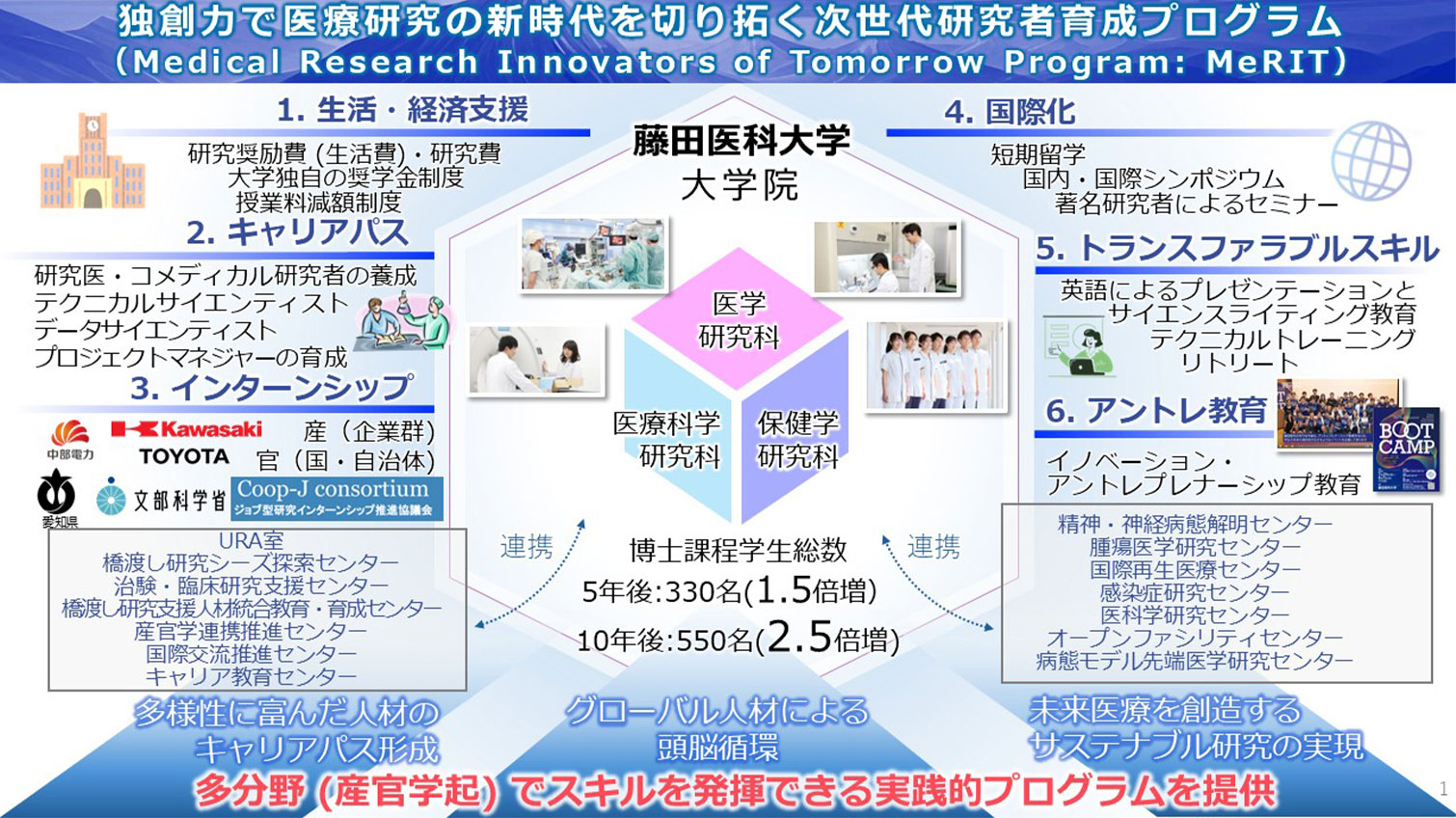
Selected students will acquire transferable skills such as advanced research techniques and effective communication, enabling them to succeed across diverse fields and industries. Additionally, tailored training programs will be implemented to develop specialized expertise aligned with their career paths.
■ Life Support and Research
Research grants will be provided to support selected students, creating an environment where they can focus solely on their research. In addition, research funds will enable students to conduct interdisciplinary studies, encouraging diverse and innovative research.
Research grants will be provided to support selected students, creating an environment where they can focus solely on their research. In addition, research funds will enable students to conduct interdisciplinary studies, encouraging diverse and innovative research.
■ Internship
Our aim is to support the personal growth and career development of graduate students as researchers. Students will identify their interests and strengths, and clarify their future career paths.
Our aim is to support the personal growth and career development of graduate students as researchers. Students will identify their interests and strengths, and clarify their future career paths.
■ Internationalization
We provide opportunities for students to experience overseas research institutions, helping them explore new research fields and broaden their skills.
Goals include learning new knowledge and techniques abroad, understanding different perspectives and methods, building international connections, gaining knowledge of special research resources, and improving language abilities.
We provide opportunities for students to experience overseas research institutions, helping them explore new research fields and broaden their skills.
Goals include learning new knowledge and techniques abroad, understanding different perspectives and methods, building international connections, gaining knowledge of special research resources, and improving language abilities.
■ Transferable skills
To increase career flexibility and enable success across various research fields and industries, we focus on developing key skills. These include communication skills to collaborate effectively and problem-solving skills to analyze complex issues and find solutions. To foster these abilities, students and young researchers will participate once a year in a two-day overnight retreat from summer to fall, in a relaxing environment away from their usual routine. During the retreat, they will exchange ideas, share research results, and build friendships.
To increase career flexibility and enable success across various research fields and industries, we focus on developing key skills. These include communication skills to collaborate effectively and problem-solving skills to analyze complex issues and find solutions. To foster these abilities, students and young researchers will participate once a year in a two-day overnight retreat from summer to fall, in a relaxing environment away from their usual routine. During the retreat, they will exchange ideas, share research results, and build friendships.
■ Entrepreneurship Education
We aim to deepen interest and understanding of diverse careers, including entrepreneurship. Students will develop a proactive attitude to shape their own lives, approach challenges positively, and build the resilience to overcome failures and setbacks independently.
We aim to deepen interest and understanding of diverse careers, including entrepreneurship. Students will develop a proactive attitude to shape their own lives, approach challenges positively, and build the resilience to overcome failures and setbacks independently.
MeRIT
Medical Research Innovators of Tomorrow Program
Fujita Health University Graduate School has launched the “MeRIT -Medical Research Innovators of Tomorrow Program-” to support the training of doctoral students and started the “MeRIT Course” in the 2025 academic year.
This program was selected by the Japan Science and Technology Agency (JST) in “Support for Pioneering Research Initiated by the Next Generation” and will provide various types of support to qualified graduate students.
The MeRIT Course aims to produce professional researchers who can immediately play an active role in industry, government, academia and start-ups.
This program was selected by the Japan Science and Technology Agency (JST) in “Support for Pioneering Research Initiated by the Next Generation” and will provide various types of support to qualified graduate students.
The MeRIT Course aims to produce professional researchers who can immediately play an active role in industry, government, academia and start-ups.
Support
| 1 | Research Grant (Amount equivalent to the cost of living) |
2,400,000 yen/year(200,000 yen/month) |
| 2 | Research Fund |
200,000 yen/year |
| 3 | Carrer Support |
Short-term study abroad Internship for national research Presentation and science writing education in English Technical Training Retreat activities etc. |
■ Support period
Four years of the standard term of study for the doctoral course
(Three years of the standard term of study for the post-doctoral course)
Four years of the standard term of study for the doctoral course
(Three years of the standard term of study for the post-doctoral course)
Course Overview
※画像クリックで拡大表示