
5-フルオロウラシル系抗がん剤の薬物代謝研究
-

-
中島 葉子 / Yoko Nakajima
小児科学講座 准教授
Department of Pediatrics, Associate Professor, Yoko Nakajima
5-フルオロウラシル系抗がん剤の薬物代謝研究
薬の代謝効率には個人差があり、薬の代謝が悪い人は薬の副作用が出やすい傾向があります。この個人差は遺伝的に決定されており、代謝にかかわる遺伝子を調べることで、どのタイプの遺伝子型が副作用と関連が強いかを調べることが可能です。
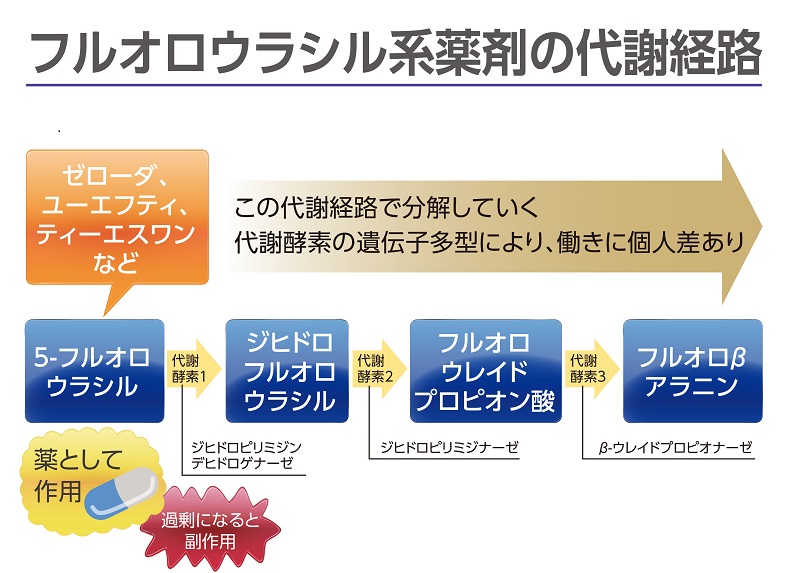
5-フルオロウラシル系の抗がん剤は広く使用されている薬ですが、稀に重篤な副作用を起こすことがあります。5-フルオロウラシル系の抗がん剤は3つの酵素で代謝、分解されますが、近年、欧米では1番目の酵素による代謝効率について薬剤投与前に遺伝学的または生化学的に検査することが推奨されました(表1;文献1,2)。また、私たちは2番目、3番目の酵素の働きの弱い人が日本人にいることを報告しました(文献3,4)。
欧米人と日本人では遺伝学的な情報に違う部分があり、副作用を来しやすい日本人での遺伝子型に関する情報が不足しています。
そこで私たちは、5-フルオロウラシル系の抗がん剤を使用される患者さんを対象に血液や尿を用いて、薬の代謝効率に関わる生化学的・遺伝学的情報を調べる研究をしています。日本人の遺伝子情報を集めることで、将来のオーダーメイド治療につながる可能性のある研究です。
Pharmacogenetic and Drug Metabolism Research on 5-Fluorouracil–Based Anticancer Agents
Drug metabolism varies substantially among individuals, and patients with reduced metabolic capacity tend to experience adverse drug reactions more frequently. Because a large part of this interindividual variability is genetically determined, analyzing genes involved in drug metabolism makes it possible to identify which genotypes are most strongly associated with toxicity.
5-Fluorouracil (5-FU)–based anticancer agents are widely used, yet they can occasionally cause severe, life-threatening adverse effects. These agents are metabolized and inactivated through three enzymes. In recent years, Europe and the United States have recommended genetic or biochemical testing of metabolic capacity mediated by the first enzyme prior to drug administration (Table 1; references 1 and 2). In addition, we have reported that some Japanese individuals have reduced activity of the second and third enzymes involved in this pathway (references 3 and 4).
Because genetic backgrounds differ between Western and Japanese populations, information on genotypes associated with 5-FU toxicity in Japanese patients remains limited.
To address this gap, we are conducting studies in patients treated with 5-FU–based chemotherapy, using blood and urine samples to assess biochemical and genetic determinants of drug metabolic capacity. By accumulating genotype data specific to the Japanese population, this work may contribute to future personalized, “tailor-made” treatment strategies that improve safety and optimize dosing.
欧米における5-フルオロウラシル系の抗がん剤の薬剤投与推奨量
| 薬物代謝が普通の人 | 薬物代謝がやや弱い人 | 薬物代謝がとても弱い人 | |
|---|---|---|---|
| 単核球中のDPD酵素活性 | 正常の70%以上 | 正常の30~70% | 正常の30%未満 |
| 遺伝子 | 正常活性の遺伝子型 |
正常活性と活性低下の 遺伝子型両方を持つ |
活性低下の遺伝子型のみ |
| 推奨される投与量 | 通常投与量 | 通常投与量の25~50% | 投与を避ける |
関連文献
- Clinical Pharmacogenetics Implementation Consortium (CPIC) Guideline for Dihydropyrimidine Dhydrogenase Genotype and Fluoropyrimidine Dosing: 2017 Update.CPIC UPDATE Volume 103 Number 2 February 2018.
- DPYD genotype-guided dose individualization to improve patient safety of fluoropyrimidine therapy:Call for a drug label update. Annals of Oncology 28: 2915–2922, 2017.
- Dihydropyrimidinase deficiency in four East Asian patients due to novel and rare DPYS mutations affecting protein structural integrity and catalytic activity. Nakajima Y, et al. Molecular Genetics and Metabolism 122 (2017) 216–222.
- Clinical, biochemical and molecular analysis of 13 Japanese patients with β-ureidopropionase deficiency demonstrates high prevalence of the c.977G > A (p.R326Q) mutation. Nakajima Y, et al. J Inherit Metab Dis. 2014 Sep;37(5):801-12.2014.
- Dihydropyrimidinase and β-ureidopropionase gene variation and severe fluoropyrimidine-related toxicity. Kummer, et al. Pharmacogenetics. 2015
- Genetic Polymorphisms of Dihydropyrimidinase in a Japanese Patient with Capecitabine-Induced Toxicity. Hiratsuka M, et al. PLOS one. 2015.
インフォメーションInformation
藤田医科大学 医学部 小児科学
〒470-1192
愛知県豊明市沓掛町田楽ヶ窪1番地98
TEL:0562-93-2111(代表)
0562-95-2216(小児科医局)
Department of Pediatrics
1-98 Dengakugakubo, Kutsukake-cho, Toyoake, Aichi 470-1192, Japan