
ウイルスの増殖機構
-

-
村田 貴之 / Takayuki Murata
ウイルス学講座 教授
Department of Virology and Parasitology, Professor, Takayuki Murata
ウイルス発がん機序の解明及び予防・治療法の開発
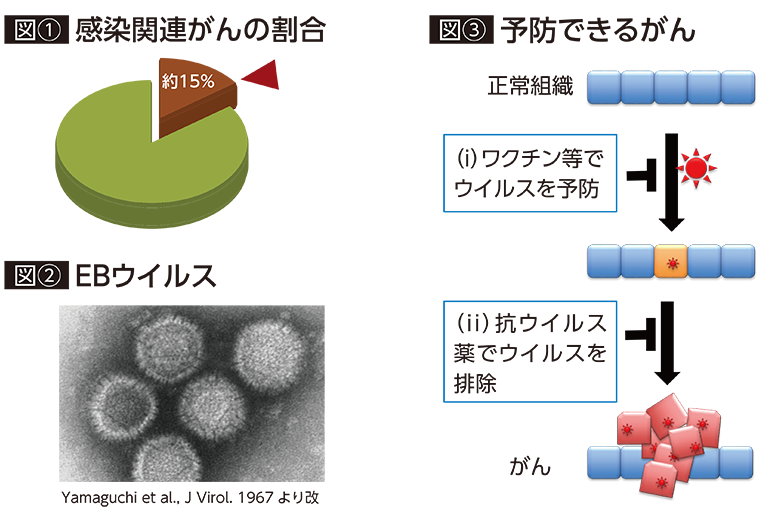
がんのうちおよそ15%が、ウイルスなどの感染が原因となって起こります(図1)。ヒトのがんの原因となるウイルスは現在、EBウイルス(図2)、カポジ肉腫関連ヘルペスウイルス、ヒトT細胞白血病ウイルス1型、B型肝炎ウイルス、C型肝炎ウイルス、ヒトパピローマウイルス、メルケル細胞ポリオーマウイルスの7種類が知られています。ウイルスが原因となって起こるがんは、(i)ワクチン等でウイルス感染を予防する、あるいは一旦感染してしまっても、(ii)抗ウイルス薬等でウイルスを排除する、ことで予防することが可能です(図3)。このため、がんウイルス研究の意義は非常に大きいと考えられます。
我々は特に、バーキットリンパ腫、ホジキンリンパ腫、慢性活動性EBV感染症(CAEBV)、T/NK細胞リンパ腫、胃癌、上咽頭癌など多様ながんの原因となるEBウイルス、カポジ肉腫や原発性滲出性リンパ腫などの原因となるカポジ肉腫関連ヘルペスウイルス、肝がんの原因となるB型肝炎ウイルスについて、ウイルス複製機構の解析、がん化機構の解析、新規薬剤の開発などの研究を行っています。
Elucidating Mechanisms of Virus-Driven Carcinogenesis and Developing Preventive and Therapeutic Strategies
Approximately 15% of human cancers are caused by infections such as viruses (Fig. 1). To date, seven viruses are known to be etiologic agents of human cancer: Epstein–Barr virus (EBV; Fig. 2), Kaposi’s sarcoma-associated herpesvirus (KSHV), human T-cell leukemia virus type 1 (HTLV-1), hepatitis B virus (HBV), hepatitis C virus (HCV), human papillomavirus (HPV), and Merkel cell polyomavirus (MCPyV). Cancers driven by viral infections can be prevented by either (i) blocking viral infection through measures such as vaccination or, even after infection has occurred, (ii) eliminating the virus using antiviral agents (Fig. 3). For these reasons, research on oncogenic viruses has substantial medical and public health significance.
Our laboratory focuses in particular on EBV, which is associated with a wide spectrum of malignancies, including Burkitt lymphoma, Hodgkin lymphoma, chronic active EBV infection (CAEBV), T/NK-cell lymphomas, gastric cancer, and nasopharyngeal carcinoma. We also study KSHV, the causative agent of Kaposi’s sarcoma and primary effusion lymphoma, as well as HBV, a major driver of hepatocellular carcinoma. Across these viruses, we investigate mechanisms of viral replication, molecular pathways of virus-induced transformation, and the development of novel therapeutic agents.
関連文献
- Murata, Microorganisms. 2021 9(4):778.
- Yanagi et al., Virology. 2021 557:44-54.
- Sugimoto et al., J Virol. 2021 02194-20.
- Mabuchi et al., Cancers. 2021 13(3):561.
- Murata et al., Rev Med Virol. 2020 30(2):e2095.
- Watanabe et al., Cancer Sci. 2020 111(1):279-287.
- Sugimoto et al., PLoS One. 2019 14(9):e0222519.
- Okuno et al., Nat Microbiol. 2019 4:404-413.
- Murata, Adv Exp Med Biol. 2018;1045:395-412.
インフォメーションInformation
Department of Virology and Parasitology
1-98 Dengakugakubo, Kutsukake-cho, Toyoake, Aichi 470-1192, Japan