
がん転移の芽を摘む
-
-
下野 洋平 / Yohei Shimono
生化学講座 教授
Department of Biochemistry, Professor, Yohei Shimono
「転移がん幹細胞」をその芽の段階で摘む
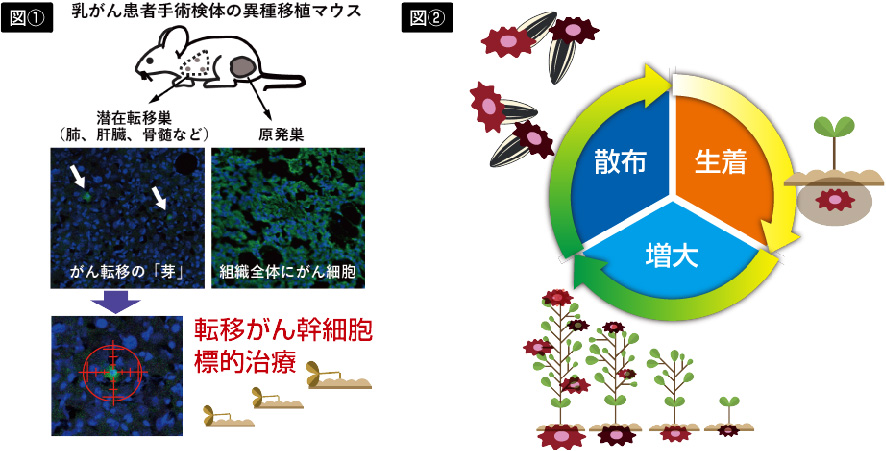
がんは転移すると依然として完治は難しいとされます。私たちは、がん患者さんの手術検体を活用した生体モデルを用いて、肝臓などから転移の初期段階にある「転移の芽」を分離し、その性質を分子レベルで解析しています(図①)。
がん転移が特定の臓器に指向性をもって起こる原因を、がん研究の巨匠Pagetは735例の女性乳がん患者の死後解剖の結果をもとに考察し、1889年に「種と土」理論を提唱しました。さらに近年の研究で、がん組織形成の根源にあるとされる「がん幹細胞」の性質をもつがん細胞は、転移病巣をつくる「種」となることが分かりました。そこで、固形がんにおけるがん幹細胞理論を提唱したスタンフォード大学のClarke教授のもとで学んだ知見を活用して、「がん幹細胞」(「種」)が転移臓器の環境(「土」)に適応して「生着」する過程(図②、「がん転移の芽」)を解析しています。
これらの研究により「種と土」理論の背景にある機構を理解して、治療困難なほど大きくなる前に「転移がん幹細胞」をその「芽」の段階で摘む方法を見出すことを目指しています。
Eliminating “metastatic cancer stem cells” at the earliest, budding stage
Cancer remains difficult to cure once it metastasizes. Using patient-derived in vivo models established from surgical specimens, we isolate early-stage metastatic foci, or “metastatic buds,” from organs such as the liver and analyze their molecular properties in detail (Fig. 1).
To explain why cancer metastasis shows tropism toward specific organs, Stephen Paget examined autopsy findings from 735 women with breast cancer and proposed the “seed and soil” hypothesis in 1889. More recent studies have shown that a subset of tumor cells with “cancer stem cell” properties, thought to lie at the root of tumor formation, can act as the “seeds” that establish metastatic lesions. Building on insights I gained under Professor Michael Clarke at Stanford University, who pioneered the cancer stem cell theory in solid tumors, we investigate how cancer stem cells (“seeds”) adapt to and successfully engraft within the microenvironment of metastatic target organs (“soil”). We focus in particular on the process by which these cells take hold, a stage we refer to as the “metastatic bud” (Fig. 2).
Through this work, we aim to uncover the mechanisms underlying the “seed and soil” hypothesis and to develop strategies to eliminate metastatic cancer stem cells while they are still in their nascent “budding” stage, before metastatic lesions grow to a size that makes them intractable.
関連文献
文責 生化学 教授 下野洋平
- Goto H et al., Oncogene. 38;767-779, 2019.
- Tominaga K et al., Oncogene. 36; 1276-1286, 2017.
- Ijuin T et al., Cancer Sci, 107: 981-990, 2016.
- Shimono Y et al., J Clin Med. 5;e2, 2016.
- Nobutani K et al., PLoS One. 10; e0130032, 2015.
- Isobe T et al., eLife. 3; e01977, 2014.
- Dalerba P et al., Nat Biotechnol. 29; 1120-1127, 2011.
- Liu H et al., Proc Natl Acad Sci U S A.107; 18115-18120, 2010.
- Shimono Y et al., Cell. 138: 592-603, 2009.
- Lobo NA et al., Ann Rev Cell Dev Biol. 23;675-699, 2007.
ニュースNews
インフォメーションInformation
藤田医科大学 医学部 生化学講座
〒470-1192
愛知県豊明市沓掛町田楽ヶ窪1番地98
大学4号館5階
TEL:0562-93-2451
Mail:biochem1(at)fujita-hu.ac.jp
(at)を@に変換して送信してください。
Department of Biochemistry
1-98 Dengakugakubo, Kutsukake-cho, Toyoake, Aichi 470-1192, Japan Fujita Health University, University Building 4