
がん転移制御を目指した薬剤開発
-

-
鈴木 元 / Motoshi Suzuki
分子腫瘍学講座 教授
Department of Molecular Oncology, Professor, Motoshi Suzuki
がん転移抑制を目指した薬剤開発
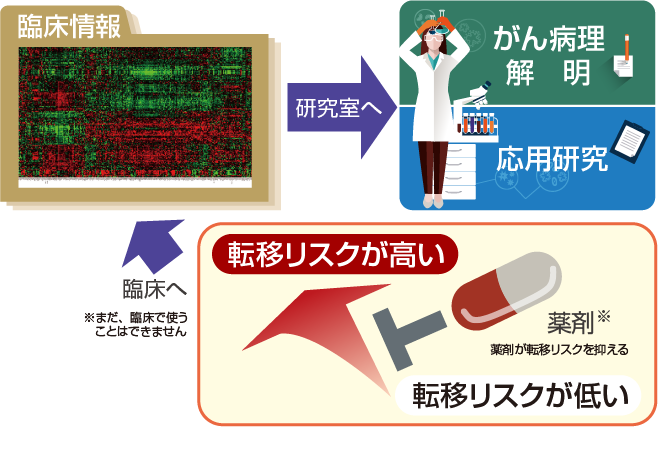
肺がんは年間死亡者数ががん腫中で1位であり、発がん過程の解明、予防、治療法の開発が強く望まれています。私たちはこれまで、肺がんの組織型特徴的な遺伝子発現プロファイルといった臨床情報に基づく研究から、肺がん発生と悪性化、転移に関係する遺伝子や経路を単離してきました。
例えば、私たちは、セラミド合成を介する肺がん転移機構の存在を発見しました。肺がんではCERS6と呼ばれるセラミド合成酵素が活発に活動をしています。その結果合成される代謝産物C16セラミドが、がん転移に必須なラメリポディアと呼ばれる構造体を形成して転移が引き起こされます。そこで、現在、この経路の詳細と、この経路を標的とした肺がん治療薬を開発中です。
また、肺がんの一部で、DNA修復因子POLD4遺伝子の発現低下が起きていることを発見しました。発現低下の起きている肺がんでは、DNA修復能が低下しており、種々の抗がん剤に対する感受性が高いと考えられます。
私たちの研究室では、この他に、放射線等によるDNA損傷、免疫細胞による生体防御に関する研究などもしています。
Drug Development Aimed at Suppressing Cancer Metastasis
Lung cancer ranks first among cancers in annual mortality, and there is a strong need to elucidate the process of carcinogenesis and to develop effective strategies for prevention and treatment. Building on clinical information, including histology-specific gene expression profiles, we have identified genes and pathways involved in lung cancer initiation, malignant progression, and metastasis.
For example, we discovered a metastasis mechanism in lung cancer mediated by ceramide synthesis. In lung cancer, a ceramide synthase called CERS6 is highly active. Its metabolic product, C16 ceramide, promotes metastasis by inducing the formation of lamellipodia, cellular protrusive structures that are essential for cell migration. We are currently investigating this pathway in detail and developing therapeutic agents for lung cancer that target it.
We also found that, in a subset of lung cancers, expression of the DNA repair factor POLD4 is reduced. In tumors with decreased POLD4 expression, DNA repair capacity is impaired, which is expected to increase sensitivity to a range of anticancer drugs.
In addition, our laboratory conducts research on DNA damage induced by radiation and other stresses, as well as on host defense mechanisms mediated by immune cells.
関連文献
- Suzuki M et al., J Cell Mol Med. 20:11949 2020.
- Kajino T et al., EMBO J. 38; e98441, 2019.
- 水谷泰嘉、鈴木元, がん生物学イラストレイテッド(羊土社)第2版; 185-192, 2019
- Sato H et al., Nat Commun. 8; 1751, 2017
- Yamaguchi T et al., Nat Commun. 7, 10060, 2016
- Mizutani Y et al., Acta Histochem Cytochem. 49; 7-19, 2016
- Niimi A et al., Genes Chromosomes Cancer. 55; 650-660, 2016
- Huang QM et al., Cancer Res. 70:8407-8416, 2010.
インフォメーションInformation
分子腫瘍学講座
〒470-1192
愛知県豊明市沓掛町田楽ヶ窪1番地98
TEL:0562-93-2440
Mail:motosuzu*fujita-hu.ac.jp
*を@に変更してください