A Short Walk Goes a Long Way for Your Gut
New research shows that gut motility increases within minutes of physical activity
Fujita Health University researchers investigated whether physical activity, like walking, can increase gut motility. Healthy adults walked for 20 minutes while bowel sounds were measured as a noninvasive indicator of gut motility. The study revealed significant increases in gut motility within just minutes after walking. These findings provide new insights into the immediate physiological effects of exercise on the digestive system and suggest a potential mechanism by which regular physical activity may help relieve constipation.
Fujita Health University researchers investigated whether physical activity, like walking, can increase gut motility. Healthy adults walked for 20 minutes while bowel sounds were measured as a noninvasive indicator of gut motility. The study revealed significant increases in gut motility within just minutes after walking. These findings provide new insights into the immediate physiological effects of exercise on the digestive system and suggest a potential mechanism by which regular physical activity may help relieve constipation.
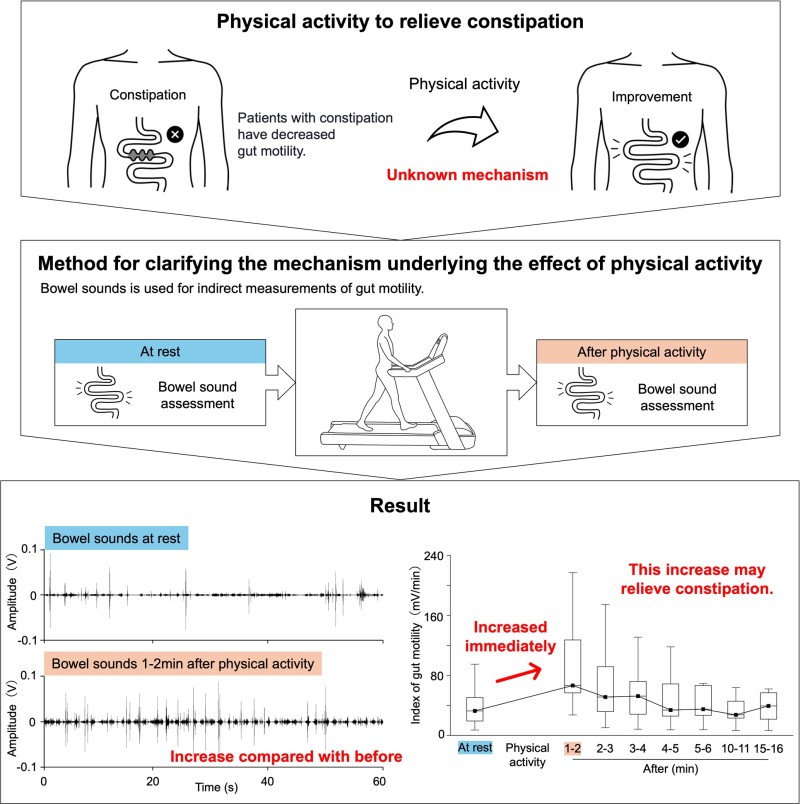
Image title: Effect of Physical Activity on Bowel Sounds as an Indicator of Gut Motility
Image caption: The upper panel illustrates reduced gut motility in patients with constipation and its improvement following physical activity through an unknown mechanism. The middle panel depicts the experimental protocol, with bowel sound assessments performed at rest and after physical activity as an indirect measure of gut motility. The lower panel shows representative bowel sound waveforms at rest and 1–2 minutes after physical activity, along with quantitative analysis demonstrating an immediate increase in the gut motility index following exercise, which may contribute to constipation relief.
Image credit: Professor Yohei Otaka and Professor Shigeo Tanabe from Fujita Health University
Image source link: Not available
Image License: Original content
License restrictions: Credit must be given to the creator.
Image caption: The upper panel illustrates reduced gut motility in patients with constipation and its improvement following physical activity through an unknown mechanism. The middle panel depicts the experimental protocol, with bowel sound assessments performed at rest and after physical activity as an indirect measure of gut motility. The lower panel shows representative bowel sound waveforms at rest and 1–2 minutes after physical activity, along with quantitative analysis demonstrating an immediate increase in the gut motility index following exercise, which may contribute to constipation relief.
Image credit: Professor Yohei Otaka and Professor Shigeo Tanabe from Fujita Health University
Image source link: Not available
Image License: Original content
License restrictions: Credit must be given to the creator.
Gut health plays a vital role in overall well-being, with constipation remaining one of the most widespread and frustrating digestive issues that people face today. It affects individuals of all ages and backgrounds, leading not only to physical discomfort such as bloating, straining, and infrequent bowel movements but also to emotional stress, reduced productivity, and a diminished quality of life. When symptoms persist, constipation can even contribute to more serious complications, including hemorrhoids, cardiovascular strain, and an elevated risk of colorectal problems. Despite its prevalence, constipation often goes unnoticed or untreated until it becomes disruptive, highlighting the need for a better understanding of both its causes and effective treatment strategies.
Among the many approaches to managing constipation, physical activity stands out as one of the simplest and most widely recommended. People who move more tend to have healthier digestion, while those who remain sedentary often struggle with slower bowel function. Yet, although the link between activity and gut health is well recognized, the biological reasons behind it remain surprisingly unclear. Most research has focused on long-term exercise habits; far less is known about what happens in the moments right after we start moving. Understanding these immediate changes could offer valuable insight into the mechanisms behind constipation relief and reveal why even short bouts of walking can make a meaningful difference.
To explore this gap, researchers from Fujita Health University undertook a study to examine how quickly physical activity affects gut motility in healthy adults. In their study, published in Scientific Reports on September 29, 2025, rather than using invasive procedures, they turned to an innovative, non-invasive method to analyze bowel sounds (BS). These sounds, created by the movement of gas and fluid through the intestines, reflect gut motility that pushes digestive contents forward. By capturing and analyzing these sounds before and after exercise, the researchers aimed to directly observe the gut’s immediate response to movement.
The study recruited 21 healthy young adults. Each participant began by lying quietly while researchers recorded one minute of baseline BS using an electronic stethoscope paired with advanced signal-processing software. Participants then walked on a treadmill for 20 minutes at a comfortable, self-selected pace. Immediately afterwards, the researchers recorded BS again at several time points over 15 minutes while the participants rested in a lying position. The team assessed gut motility using three indicators: the Sound Index (SI), which measures the total amplitude of sound activity; the percentage of time that BS were present; and the number of distinct BS events per minute.
The findings were both clear and compelling. Within just one to two minutes of finishing the walk, all three measures increased significantly compared to the resting baseline. BS amplitude nearly doubled, sounds occurred for a much larger portion of the recording, and the number of individual sounds per minute rose noticeably. Although these increases faded within two to three minutes, their rapid onset reveals something important: even light physical activity can trigger an immediate, measurable boost in gut motility.
These results carry meaningful implications. Professor Yohei Otaka, senior author of the study, shares, “Walking can serve as an effective, immediate tool for stimulating bowel function. The findings also point to potential underlying mechanisms, such as changes in autonomic nervous system activity or reflexes triggered by the body’s natural oscillations during movement.”
The research team also included Professor Shigeo Tanabe (Graduate School of Health Sciences, Fujita Health University) and Kento Katagiri (Department of Rehabilitation Medicine, School of Medicine, Fujita Health University), who contributed to study design, analysis, and manuscript preparation.
Furthermore, the study suggests that BS analysis could become a valuable, non-invasive technique for future research on gastrointestinal health and constipation.
In conclusion, this study offers fresh insight into how quickly the digestive system responds to physical activity. By showing that gut motility increases almost immediately after walking, it may help explain why movement is such an effective strategy for managing constipation and reinforces the broader importance of staying active for digestive health and overall well-being.
Among the many approaches to managing constipation, physical activity stands out as one of the simplest and most widely recommended. People who move more tend to have healthier digestion, while those who remain sedentary often struggle with slower bowel function. Yet, although the link between activity and gut health is well recognized, the biological reasons behind it remain surprisingly unclear. Most research has focused on long-term exercise habits; far less is known about what happens in the moments right after we start moving. Understanding these immediate changes could offer valuable insight into the mechanisms behind constipation relief and reveal why even short bouts of walking can make a meaningful difference.
To explore this gap, researchers from Fujita Health University undertook a study to examine how quickly physical activity affects gut motility in healthy adults. In their study, published in Scientific Reports on September 29, 2025, rather than using invasive procedures, they turned to an innovative, non-invasive method to analyze bowel sounds (BS). These sounds, created by the movement of gas and fluid through the intestines, reflect gut motility that pushes digestive contents forward. By capturing and analyzing these sounds before and after exercise, the researchers aimed to directly observe the gut’s immediate response to movement.
The study recruited 21 healthy young adults. Each participant began by lying quietly while researchers recorded one minute of baseline BS using an electronic stethoscope paired with advanced signal-processing software. Participants then walked on a treadmill for 20 minutes at a comfortable, self-selected pace. Immediately afterwards, the researchers recorded BS again at several time points over 15 minutes while the participants rested in a lying position. The team assessed gut motility using three indicators: the Sound Index (SI), which measures the total amplitude of sound activity; the percentage of time that BS were present; and the number of distinct BS events per minute.
The findings were both clear and compelling. Within just one to two minutes of finishing the walk, all three measures increased significantly compared to the resting baseline. BS amplitude nearly doubled, sounds occurred for a much larger portion of the recording, and the number of individual sounds per minute rose noticeably. Although these increases faded within two to three minutes, their rapid onset reveals something important: even light physical activity can trigger an immediate, measurable boost in gut motility.
These results carry meaningful implications. Professor Yohei Otaka, senior author of the study, shares, “Walking can serve as an effective, immediate tool for stimulating bowel function. The findings also point to potential underlying mechanisms, such as changes in autonomic nervous system activity or reflexes triggered by the body’s natural oscillations during movement.”
The research team also included Professor Shigeo Tanabe (Graduate School of Health Sciences, Fujita Health University) and Kento Katagiri (Department of Rehabilitation Medicine, School of Medicine, Fujita Health University), who contributed to study design, analysis, and manuscript preparation.
Furthermore, the study suggests that BS analysis could become a valuable, non-invasive technique for future research on gastrointestinal health and constipation.
In conclusion, this study offers fresh insight into how quickly the digestive system responds to physical activity. By showing that gut motility increases almost immediately after walking, it may help explain why movement is such an effective strategy for managing constipation and reinforces the broader importance of staying active for digestive health and overall well-being.
Reference
Title of original paper:
Immediate effect of physical activity on gut motility in healthy adultsJournal:
Scientific ReportsDOI:
10.1038/s41598-025-18860-8About Professor Yohei Otaka from Fujita Health University
Professor Yohei Otaka holds an M.D. and Ph.D. in Medicine from Keio University and is the Chairman of the Department of Rehabilitation Medicine at Fujita Health University School of Medicine in Japan. With more than two decades of academic experience, he has authored approximately 262 publications. His research centers on stroke rehabilitation, rehabilitative robotics, fall prevention, and advanced assistive technologies. Among his notable achievements, he directs the university’s Research Center for Robotic Smart Home & Activity Assistive Technology and has produced influential studies on post-stroke functional recovery, motivation in rehabilitation, and robotics-based gait reconstruction.
Funding information
This work was supported by the Aichi Society for Physical Therapy.