Virtual-Reality Path Integration for Predicting Risk of Neurodegenerative Diseases
Virtual-reality-based navigation errors may reveal hidden Alzheimer’s-related changes long before symptoms arise
While virtual-reality path integration (VR-PI) may reveal subtle changes that precede the onset of clinical cognitive symptoms, the association between PI performance and structural brain changes remains unclear. Now, researchers have demonstrated that poor PI performance is linked to accelerated cortical thinning in several brain regions and is tied to key blood biomarkers of neurodegeneration. The findings suggest that VR navigation tasks may offer a non-invasive approach for early detection of neurodegenerative diseases.
Alzheimer’s disease (AD) often begins long before it is clinically recognized, with subtle brain changes emerging years before noticeable memory loss or cognitive decline. Among the earliest regions affected are the hippocampus and entorhinal cortex, areas essential for spatial navigation. This has led researchers to look beyond memory and explore navigation ability as a potential early indicator of the disease. One key component of navigation is path integration (PI), the brain’s ability to track position and direction using internal cues such as movement and balance. As these systems begin to deteriorate, disruptions in PI may appear early, making it a promising behavioral marker of preclinical AD. Despite growing interest in this idea, a key question is whether PI deficits can predict structural brain changes.
To address this, a team of researchers led by Senior Assistant Professor Kazuya Kawabata, Dr. Sayuri Shima, and Prof. Hirohisa Watanabe from the Department of Neurology, Fujita Health University, Japan, conducted a study to examine whether subtle impairments in virtual-reality PI (VR-PI) could signal future neurodegeneration in cognitively healthy individuals. Their findings were published in the journal Alzheimer's Research & Therapy on April 20, 2026.
The study followed 71 cognitively unimpaired adults over approximately one year. At baseline, participants completed an immersive VR navigation task designed to assess PI ability. In this task, individuals navigated a circular virtual environment, visited two checkpoints, and were then asked to return to their starting point without visual cues. Two primary measures were derived: PI error (distance from the true starting point) and angular error (directional deviation). In addition, high-resolution magnetic resonance imaging (MRI) scans were analyzed to assess structural changes such as longitudinal cortical thickness and volume. Moreover, Alzheimer’s-related plasma biomarkers, including p-tau181 and glial fibrillary acidic protein (GFAP), were assessed. Longitudinal brain changes were analyzed using linear mixed-effects models to evaluate whether baseline PI performance predicted structural decline.
The results revealed a clear pattern. Individuals with higher PI error at baseline showed greater cortical thinning and volume loss over the follow-up period. These changes were observed in brain regions known to be vulnerable in early AD, including the parahippocampal gyrus, middle temporal gyrus, posterior cingulate cortex, and caudal middle frontal gyrus.
Notably, angular error showed similar patterns of association while exhibiting weaker age-related effects, supporting the robustness of navigation-based measures.
Importantly, these behavioral findings were closely tied to biological processes. Higher PI and angular errors were associated with increased levels of plasma p-tau181, while PI error was also linked to GFAP levels. This indicates that navigation deficits are not merely performance differences but reflect underlying neurodegenerative changes. In fact, PI error was able to identify individuals with the most rapid brain decline, particularly in the parahippocampal region, with high accuracy.
“Our findings suggest that VR-PI performance captures both molecular (blood biomarker) and structural (MRI) signatures that emerge before overt clinical impairment,” says Dr. Kawabata.
This dual link strengthens its potential as an early and sensitive marker of neurodegenerative vulnerability.
Overall, this study demonstrates that impaired PI is closely associated with subsequent brain degeneration and Alzheimer’s-related biomarkers, even among cognitively healthy individuals. By bridging behavior, brain structure, and molecular signals, it highlights VR-PI performance as a promising early indicator of AD and a potential tool for its early detection and monitoring.
“Our approach may allow earlier identification of risk of neurodegenerative diseases, including AD. Over the longer term, it may contribute to a shift toward earlier detection, potentially enabling timely therapeutic interventions at preclinical stages and delaying disease progression, thereby preserving cognitive function and quality of life,” concludes Dr. Kawabata.
While virtual-reality path integration (VR-PI) may reveal subtle changes that precede the onset of clinical cognitive symptoms, the association between PI performance and structural brain changes remains unclear. Now, researchers have demonstrated that poor PI performance is linked to accelerated cortical thinning in several brain regions and is tied to key blood biomarkers of neurodegeneration. The findings suggest that VR navigation tasks may offer a non-invasive approach for early detection of neurodegenerative diseases.
Alzheimer’s disease (AD) often begins long before it is clinically recognized, with subtle brain changes emerging years before noticeable memory loss or cognitive decline. Among the earliest regions affected are the hippocampus and entorhinal cortex, areas essential for spatial navigation. This has led researchers to look beyond memory and explore navigation ability as a potential early indicator of the disease. One key component of navigation is path integration (PI), the brain’s ability to track position and direction using internal cues such as movement and balance. As these systems begin to deteriorate, disruptions in PI may appear early, making it a promising behavioral marker of preclinical AD. Despite growing interest in this idea, a key question is whether PI deficits can predict structural brain changes.
To address this, a team of researchers led by Senior Assistant Professor Kazuya Kawabata, Dr. Sayuri Shima, and Prof. Hirohisa Watanabe from the Department of Neurology, Fujita Health University, Japan, conducted a study to examine whether subtle impairments in virtual-reality PI (VR-PI) could signal future neurodegeneration in cognitively healthy individuals. Their findings were published in the journal Alzheimer's Research & Therapy on April 20, 2026.
The study followed 71 cognitively unimpaired adults over approximately one year. At baseline, participants completed an immersive VR navigation task designed to assess PI ability. In this task, individuals navigated a circular virtual environment, visited two checkpoints, and were then asked to return to their starting point without visual cues. Two primary measures were derived: PI error (distance from the true starting point) and angular error (directional deviation). In addition, high-resolution magnetic resonance imaging (MRI) scans were analyzed to assess structural changes such as longitudinal cortical thickness and volume. Moreover, Alzheimer’s-related plasma biomarkers, including p-tau181 and glial fibrillary acidic protein (GFAP), were assessed. Longitudinal brain changes were analyzed using linear mixed-effects models to evaluate whether baseline PI performance predicted structural decline.
The results revealed a clear pattern. Individuals with higher PI error at baseline showed greater cortical thinning and volume loss over the follow-up period. These changes were observed in brain regions known to be vulnerable in early AD, including the parahippocampal gyrus, middle temporal gyrus, posterior cingulate cortex, and caudal middle frontal gyrus.
Notably, angular error showed similar patterns of association while exhibiting weaker age-related effects, supporting the robustness of navigation-based measures.
Importantly, these behavioral findings were closely tied to biological processes. Higher PI and angular errors were associated with increased levels of plasma p-tau181, while PI error was also linked to GFAP levels. This indicates that navigation deficits are not merely performance differences but reflect underlying neurodegenerative changes. In fact, PI error was able to identify individuals with the most rapid brain decline, particularly in the parahippocampal region, with high accuracy.
“Our findings suggest that VR-PI performance captures both molecular (blood biomarker) and structural (MRI) signatures that emerge before overt clinical impairment,” says Dr. Kawabata.
This dual link strengthens its potential as an early and sensitive marker of neurodegenerative vulnerability.
Overall, this study demonstrates that impaired PI is closely associated with subsequent brain degeneration and Alzheimer’s-related biomarkers, even among cognitively healthy individuals. By bridging behavior, brain structure, and molecular signals, it highlights VR-PI performance as a promising early indicator of AD and a potential tool for its early detection and monitoring.
“Our approach may allow earlier identification of risk of neurodegenerative diseases, including AD. Over the longer term, it may contribute to a shift toward earlier detection, potentially enabling timely therapeutic interventions at preclinical stages and delaying disease progression, thereby preserving cognitive function and quality of life,” concludes Dr. Kawabata.
Reference
Title of original paper:
VR-based path integration predicts individual risk of rapid cortical decline: a one-year longitudinal study in cognitively unimpaired adultsJournal:
Alzheimer's Research & TherapyDOI:
10.1186/s13195-026-02056-x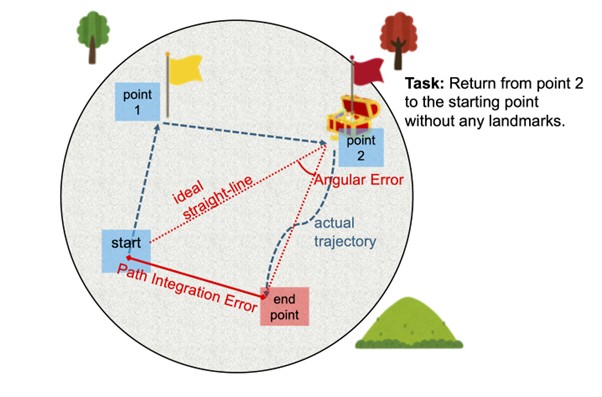
Image title: Three-dimensional virtual reality (3D VR) task
Image caption: Researchers assess navigation performance using a head-mounted immersive 3D VR device and demonstrate that VR path integration performance may help predict risk of neurodegenerative diseases, including Alzheimer's disease, potentially facilitating timely lifestyle modifications and therapeutic interventions.
Image credit: Dr. Hirohisa Watanabe from Fujita Health University, Japan
Image source link: https://link.springer.com/article/10.1186/s13195-026-02056-x
License type: CC BY 4.0
Usage restrictions: Credit must be given to the creator.
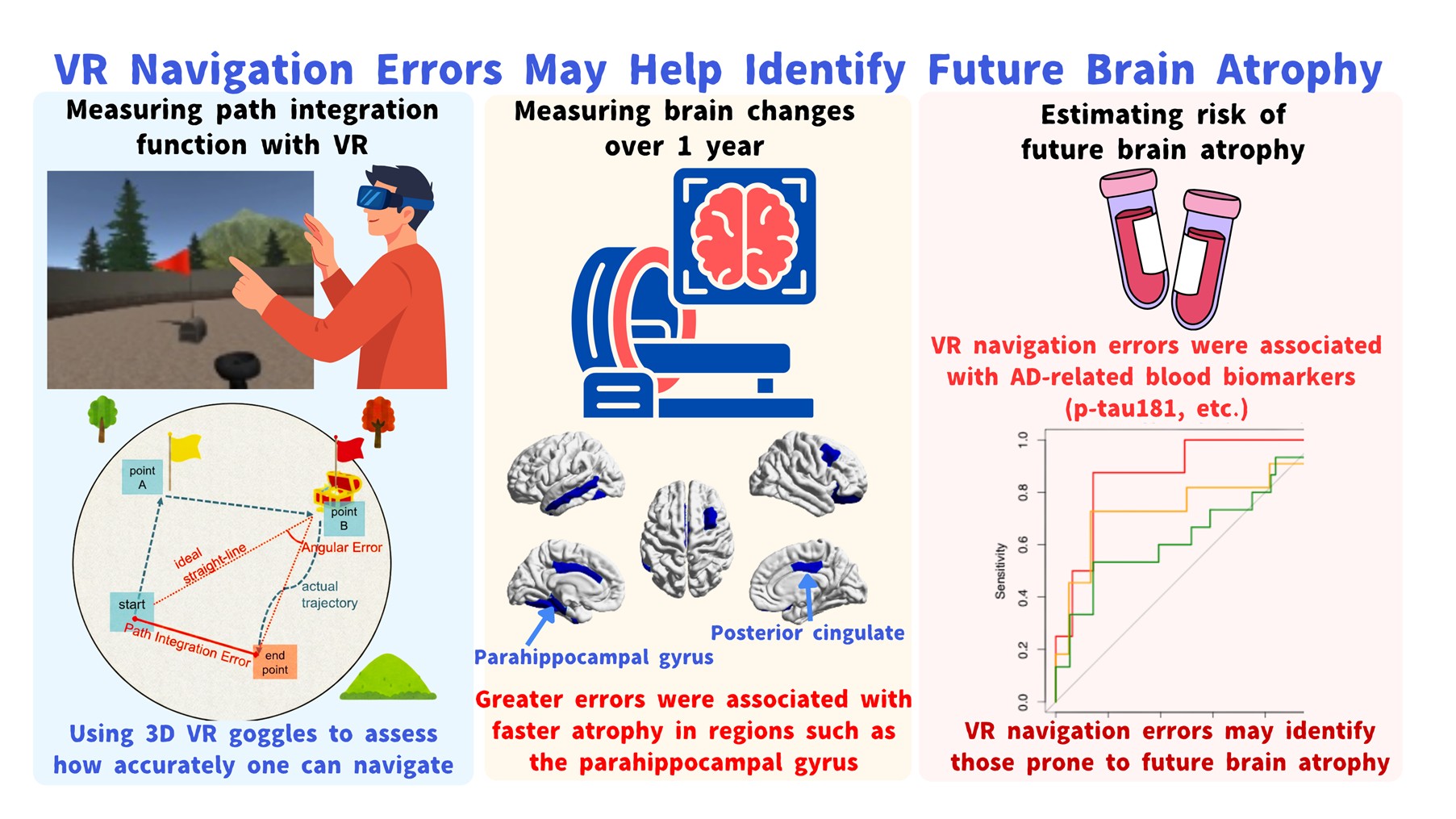
Image title: Association between path integration (PI) performance and structural brain changes
Image caption: Researchers reveal that baseline virtual-reality PI performance is associated with accelerated cortical thinning in vulnerable brain regions and is tied to key blood biomarkers such as p-tau181 and glial fibrillary acidic protein levels of neurodegeneration.
Image credit: Dr. Hirohisa Watanabe from Fujita Health University, Japan
License type: Original content
Usage restrictions: Cannot be reused without permission
About Dr. Kazuya Kawabata from Fujita Health University
Dr. Kazuya Kawabata is a Senior Assistant Professor at the Department of Neurology, Fujita Health University, Japan. He has over a decade of research experience and has authored over 80 publications with 1,084 citations. His research focuses on Parkinson’s disease, cognitive dysfunction, integrating multimodal neuroimaging, clinical assessments, and blood and cerebrospinal fluid biomarkers to enable early diagnosis of neurodegenerative diseases. He is recognized as an Outstanding Reviewer for journals like npj Parkinson’s Disease.
Funding information
This work was supported by the Japan Agency for Medical Research and Development (AMED; grant number JP21wm0425016, JP256f0137005, JP266f0137005, JP276f0137005). This research was also supported by the Fujita Mind-Brain Research & Innovation Center for Drug Generation (Fujita Mind-BRIDGe) of the Japan’s Peak Research Universities (J-PEAKS) Program (JPJS00420240019) funded by the Japan Society for the Promotion of Science (JSPS). In addition, this study was partly supported by AMED (grant number JP22dk0207055) awarded to Takahiko Tokuda. The authors declare that this study received permission to use 3D VR goggles from MIG Inc. (Tokyo, Japan).