Robot-Assisted Surgery Shows Clinical Advantages Over Laparoscopic Surgery for Gastric Cancer
Researchers find robotic gastrectomy reduces complications, blood loss, and hospital stay compared with laparoscopic surgery for gastric cancer patients
Laparoscopic gastrectomy is a well-established but technically demanding treatment against gastric cancer. Robotic gastrectomy, developed to overcome these limitations, has gained popularity in Japan since national health insurance coverage began in 2018. This study comparing matched patient pairs treated between 2023–2024 found that robotic gastrectomy reduced blood loss, conversions to open surgery, and hospital stays. Robotic distal gastrectomy also lowered complications and infections, supporting adoption to improve outcomes with minimally invasive surgery in Japan.
Surgery remains the primary curative treatment for gastric cancer, with laparoscopic gastrectomy (LG) established as a standard minimally invasive approach. While LG offers faster recovery than open surgery, it remains technically demanding because surgeons must operate within a confined space using rigid instruments that can amplify hand tremors. Robotic gastrectomy (RG) was developed to overcome these limitations by providing greater precision, enhanced dexterity, and improved visualization. Although RG has become increasingly common, whether it delivers meaningful clinical benefits over conventional laparoscopic surgery in routine practice has remained uncertain.
In Japan, RG was approved for national insurance coverage in 2018, followed by regulatory changes that expanded access to robotic surgery and increased the number of surgeons qualified to perform the procedure. Five years later, researchers sought to determine whether these advances had translated into better outcomes for patients undergoing gastric cancer surgery. Their findings were published on May 29, 2026, in the journal Gastric Cancer.
The study was led by Professor Susumu Shibasaki from the Department of Surgery, Fujita Health University–Okazaki Medical Center, Japan, together with Dr. Koichi Suda from Fujita Health University, Dr. Hideki Endo from the University of Tokyo, Dr. Ken Shirabe from Gunma University, and colleagues. The study was conducted with the support of the Japanese Gastric Cancer Association.
To answer this question, the researchers analyzed data from Japan's National Clinical Database, identifying patients who underwent minimally invasive distal gastrectomy (DG) or total gastrectomy (TG) between January 2023 and December 2024. Using propensity score matching to account for differences between patients, they compared 9,743 matched pairs of robotic and laparoscopic DG cases, as well as 1,617 matched pairs of robotic and laparoscopic TG cases. “RG has become broadly integrated into routine clinical practice across Japan. Under these contemporary conditions, it remains essential to clarify whether RG offers tangible clinical advantages over LG,” says Prof. Shibasaki.
The analysis showed that robotic procedures consistently required more operating time than laparoscopic surgery. On average, robotic DG took approximately 50 minutes longer than laparoscopic surgery, while robotic TG required nearly 70 additional minutes.
Despite the longer procedures, robotic surgery demonstrated several important clinical advantages. For both DG and TG, robotic surgery resulted in 33–40% less blood loss, a 50–65% lower likelihood of conversion to open surgery, and shorter postoperative hospital stays than laparoscopic surgery. Among patients undergoing DG, robotic surgery also reduced serious postoperative complications and intra-abdominal infections compared with laparoscopic surgery.
“Although the absolute magnitudes of these differences were small, the consistent benefits across multiple perioperative outcomes indicate that RG may achieve a level of minimal invasiveness beyond LG, which itself is a highly refined minimally invasive approach,” says Prof. Shibasaki, adding that these benefits could be seen even in a large and diverse nationwide cohort.
The findings also suggest that RG has continued to improve since its introduction into routine care. Compared with an earlier nationwide study conducted before national insurance coverage was approved in 2018, the current analysis found better outcomes following robotic surgery. The researchers believe these improvements reflect ongoing advances in robotic technology, greater surgical experience, and expanded training opportunities over the past several years.
The benefits, however, were not identical across all procedures. While robotic DG significantly reduced major postoperative complications, robotic TG did not show a significant improvement in this primary outcome compared with laparoscopic surgery. According to the researchers, TG remains a more technically demanding procedure, and surgeons perform it less frequently, limiting opportunities to gain experience with robotic techniques.
Looking ahead, the researchers believe continued technological innovation and broader adoption of robotic surgery will further improve outcomes for patients with gastric cancer. “Over the next 5–10 years, these findings are expected to accelerate the widespread adoption of robotic surgery. As a result, more patients will have access to safer, higher quality surgical care, leading to better recovery, fewer complications, and improved overall outcomes,” he concludes.
Laparoscopic gastrectomy is a well-established but technically demanding treatment against gastric cancer. Robotic gastrectomy, developed to overcome these limitations, has gained popularity in Japan since national health insurance coverage began in 2018. This study comparing matched patient pairs treated between 2023–2024 found that robotic gastrectomy reduced blood loss, conversions to open surgery, and hospital stays. Robotic distal gastrectomy also lowered complications and infections, supporting adoption to improve outcomes with minimally invasive surgery in Japan.
Surgery remains the primary curative treatment for gastric cancer, with laparoscopic gastrectomy (LG) established as a standard minimally invasive approach. While LG offers faster recovery than open surgery, it remains technically demanding because surgeons must operate within a confined space using rigid instruments that can amplify hand tremors. Robotic gastrectomy (RG) was developed to overcome these limitations by providing greater precision, enhanced dexterity, and improved visualization. Although RG has become increasingly common, whether it delivers meaningful clinical benefits over conventional laparoscopic surgery in routine practice has remained uncertain.
In Japan, RG was approved for national insurance coverage in 2018, followed by regulatory changes that expanded access to robotic surgery and increased the number of surgeons qualified to perform the procedure. Five years later, researchers sought to determine whether these advances had translated into better outcomes for patients undergoing gastric cancer surgery. Their findings were published on May 29, 2026, in the journal Gastric Cancer.
The study was led by Professor Susumu Shibasaki from the Department of Surgery, Fujita Health University–Okazaki Medical Center, Japan, together with Dr. Koichi Suda from Fujita Health University, Dr. Hideki Endo from the University of Tokyo, Dr. Ken Shirabe from Gunma University, and colleagues. The study was conducted with the support of the Japanese Gastric Cancer Association.
To answer this question, the researchers analyzed data from Japan's National Clinical Database, identifying patients who underwent minimally invasive distal gastrectomy (DG) or total gastrectomy (TG) between January 2023 and December 2024. Using propensity score matching to account for differences between patients, they compared 9,743 matched pairs of robotic and laparoscopic DG cases, as well as 1,617 matched pairs of robotic and laparoscopic TG cases. “RG has become broadly integrated into routine clinical practice across Japan. Under these contemporary conditions, it remains essential to clarify whether RG offers tangible clinical advantages over LG,” says Prof. Shibasaki.
The analysis showed that robotic procedures consistently required more operating time than laparoscopic surgery. On average, robotic DG took approximately 50 minutes longer than laparoscopic surgery, while robotic TG required nearly 70 additional minutes.
Despite the longer procedures, robotic surgery demonstrated several important clinical advantages. For both DG and TG, robotic surgery resulted in 33–40% less blood loss, a 50–65% lower likelihood of conversion to open surgery, and shorter postoperative hospital stays than laparoscopic surgery. Among patients undergoing DG, robotic surgery also reduced serious postoperative complications and intra-abdominal infections compared with laparoscopic surgery.
“Although the absolute magnitudes of these differences were small, the consistent benefits across multiple perioperative outcomes indicate that RG may achieve a level of minimal invasiveness beyond LG, which itself is a highly refined minimally invasive approach,” says Prof. Shibasaki, adding that these benefits could be seen even in a large and diverse nationwide cohort.
The findings also suggest that RG has continued to improve since its introduction into routine care. Compared with an earlier nationwide study conducted before national insurance coverage was approved in 2018, the current analysis found better outcomes following robotic surgery. The researchers believe these improvements reflect ongoing advances in robotic technology, greater surgical experience, and expanded training opportunities over the past several years.
The benefits, however, were not identical across all procedures. While robotic DG significantly reduced major postoperative complications, robotic TG did not show a significant improvement in this primary outcome compared with laparoscopic surgery. According to the researchers, TG remains a more technically demanding procedure, and surgeons perform it less frequently, limiting opportunities to gain experience with robotic techniques.
Looking ahead, the researchers believe continued technological innovation and broader adoption of robotic surgery will further improve outcomes for patients with gastric cancer. “Over the next 5–10 years, these findings are expected to accelerate the widespread adoption of robotic surgery. As a result, more patients will have access to safer, higher quality surgical care, leading to better recovery, fewer complications, and improved overall outcomes,” he concludes.
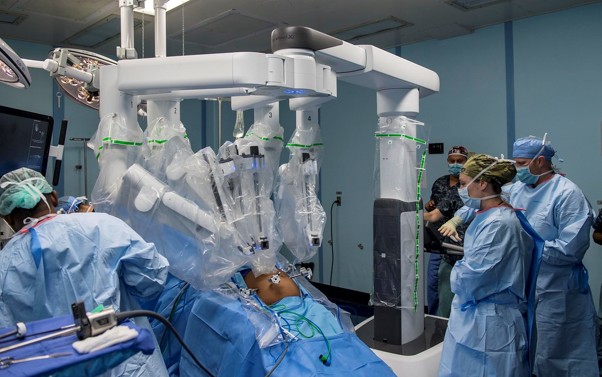
Image title: Robotic surgery setup
Image caption: A comparison of patient outcomes after robotic and laparoscopic gastrectomy in Japan has found that robotic gastrectomy is associated with fewer complications, lower blood loss, lower risk of infections, and shorter hospital stay. Future advancements and better training for surgeons will produce better outcomes for patients with gastric cancer.
Image credit: Commander, U.S. 7th Fleet from Openverse
Image link: https://openverse.org/image/8136e05d-831c-46d9-afc1-b91270eebe70?q=robotic-assisted+surgery&p=37
License type: CC BY-SA 2.0
Usage restrictions: Credit must be given to the creator. Adaptations must be shared under the same terms
Reference
Title of original paper:
Clinical advantages of robotic gastrectomy for gastric cancer over conventional laparoscopic approach: a retrospective cohort study using a nationwide registry database in JapanJournal:
Gastric CancerDOI:
10.1007/s10120-026-01764-5About Professor Susumu Shibasaki from Fujita Health University
Susumu Shibasaki is a Professor in the Department of Surgery at Fujita Health University, Japan. He received his Ph.D. in Gastrointestinal Surgery from Hokkaido University in 2012. His research focuses on minimally invasive and robotic surgery for the treatment of gastric and upper gastrointestinal disorders. Prof. Shibasaki has authored more than 200 peer-reviewed publications. In addition to his academic and research activities, he serves as the Chief of Upper Gastrointestinal Surgery at Fujita Health University's Okazaki Medical Center.
Funding information
This work was not supported by any grants or funding sources.