Rare Sugar d-Sorbose May Help Control Allergic and Autoimmune Diseases
Researchers reveal how d-sorbose reshapes cellular metabolism to promote regulatory T cells and suppress allergic airway inflammation and autoimmune diabetes
Rare sugars may offer new ways to regulate immune responses and control inflammatory diseases. Researchers have now discovered that d-sorbose, a naturally scarce monosaccharide, promotes the differentiation of regulatory T cells (Tregs) by inhibiting the hexosamine biosynthetic pathway (HBP). In mouse models, d-sorbose reduced allergic airway inflammation and prevented autoimmune diabetes, highlighting its potential as a future dietary or therapeutic intervention for managing inflammatory and autoimmune conditions.
Rare sugars are naturally occurring monosaccharides that are scarce in nature and are not readily used by the body as energy sources. Some have physiological effects beyond sweetness, raising interest in their potential health applications. One such sugar, d-sorbose, is a structural relative of d-fructose, but its effects on immune cells have remained unclear. Regulatory T cells (Tregs), identified by the Foxp3 protein, help restrain excessive immune responses and maintain immune balance. Whether a rare sugar can promote these cells has been little explored.
Addressing this challenge, the research team was led by Professor Masato Hoshi, Dr. Fumiaki Sato, and Dr. Kuniaki Saito from the Department of Disease Systems Analysis Medicine, Fujita Health University School of Medical Sciences, Japan. The researchers tested d-sorbose in cultures of mouse naïve CD4+ T cells and in two mouse models: ovalbumin (OVA)-induced allergic airway inflammation and spontaneous autoimmune diabetes in non-obese diabetic (NOD) mice. They assessed T-cell survival, immune cell activity, tissue changes, and intracellular metabolites. The study was made available online on August 28, 2026, and published on September 01, 2026, in Volume 40, Issue 17, of The FASEB Journal.
In cell cultures, d-sorbose increased Foxp3+ Treg frequency to levels comparable to d-mannose, a known Treg-promoting sugar. Unlike d-mannose, d-sorbose did not reduce CD8+ T-cell frequency, and it did not compromise T-cell viability. In OVA-challenged mice, d-sorbose increased Treg frequency in the mediastinal lymph nodes and inflamed lungs. These Tregs showed stronger suppressive activity and produced more interleukin-10 (IL-10), an anti-inflammatory molecule. Airway inflammation was reduced, while depleting Tregs abolished the protective effect, indicating that these cells were central to the response.
The team then investigated autoimmune diabetes in NOD mice. Although 60% of untreated control mice developed high blood glucose, d-sorbose-treated mice remained normoglycemic throughout the study. Their pancreatic islets showed less lymphocyte infiltration and better-preserved tissue structure. During early disease, Treg frequency and absolute numbers increased in the blood and pancreatic lymph nodes, and Tregs were detected in pancreatic islets. These results suggest that d-sorbose can influence immune responses in both allergic and autoimmune disease models.
Metabolic analyses helped explain how the sugar may work. In T cells, d-sorbose reduced metabolites associated with glycolysis, the pentose phosphate pathway (PPP), and the hexosamine biosynthetic pathway (HBP), including UDP-N-acetylglucosamine (UDP-GlcNAc). It increased malate, a tricarboxylic acid cycle intermediate. Further experiments inhibiting glutamine–fructose-6-phosphate aminotransferase, restricting glutamine, and restoring N-acetyl-d-glucosamine levels implicated coordinated changes in glucose partitioning and glutamine metabolism. The findings indicate that Treg differentiation involves broader metabolic reprogramming, rather than HBP inhibition alone.
“We wanted to understand whether naturally derived ingredients, such as rare sugars, could help regulate immune responses,” says Prof. Hoshi. “Our findings suggest that d-sorbose influences T-cell metabolism in a way that favors the development of regulatory T cells.” This work points to a possible route for developing new immunomodulatory agents or functional food ingredients for inflammatory conditions.
Overall, d-sorbose emerges as a promising candidate for further research into allergic and autoimmune diseases. However, the findings are based on cell experiments and mouse models; effectiveness, suitable intake, and long-term safety in humans have not been established. The specific enzymes directly affected by d-sorbose also remain unidentified. Further studies are needed before dietary supplements or treatments can be recommended. “Clarifying how sugar metabolism shapes immune cell function will be important for assessing its future potential,” concludes Prof. Hoshi.
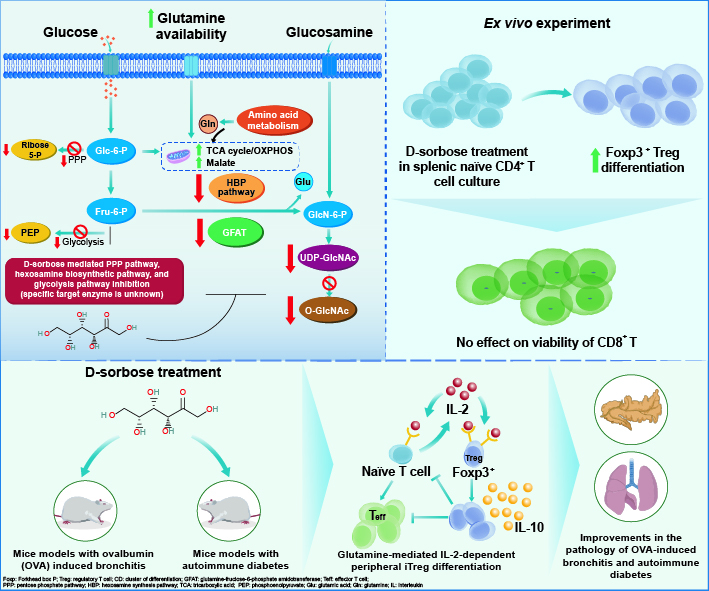
Image Caption: d-Sorbose promotes Foxp3+ regulatory T-cell differentiation by altering glucose partitioning and glutamine metabolism, suppressing glycolysis, the pentose phosphate pathway, and the hexosamine biosynthetic pathway. These metabolic changes are associated with reduced allergic airway inflammation and protection against autoimmune diabetes in mice.
Image Credit: Professor Masato Hoshi from Fujita Health University, Japan
Image Source Link: https://doi.org/10.1096/fj.202601110R
License Type: CC BY 4.0
Usage restriction: Credit must be given to the creator.
Reference
Title of original paper:
d-Sorbose Promotes Regulatory T-Cell Differentiation and Ameliorates Autoimmune and Allergic Diseases via Hexosamine Biosynthetic Pathway InhibitionJournal
The FASEB JournalDOI:
10.1096/fj.202601110RAbout Professor Masato Hoshi from Fujita Health University
Prof. Masato Hoshi is a medical researcher and clinical laboratory specialist at Fujita Health University in Toyoake, Japan. He serves as a Professor in the Department of Disease Systems Analysis Medicine and a Professor in the Graduate School of Medical Sciences. Additionally, Prof. Hoshi serves as Chief Medical Technologist in the Department of Clinical Laboratory Medicine at Fujita Health University Hospital, having assumed this leadership role in April 2025. With 65 publications and 1,525 citations, his primary research focuses on translational immunology, clinical chemistry, and metabolic pathways in immune cells to advance modern medical science.
Funding information
This study was supported by JSPS KAKENHI (Grant Number 25K14944), Fujita Health University Grant, and Matsutani Chemical Industry Co., Ltd.